A new device was about to enter
a well-developed category occupied
by well-established incumbents.
It was not in that category at all.
Klüvo
Klüvo is a dental imaging company in Zurich, then operating as Zaamigo. Its device lights the teeth with an LED, takes a flat photograph, and builds the 3D model from that photograph in software. It needs no emitter, no cord, and no cooling.
At the start of the engagement the product worked, and the company had a specification sheet no dental scanner could match. What it did not have was an explanation of why.
The Symptom
“We specialize in developing and selling an innovative intraoral scanner. Our primary target audience consists of dental professionals.”
The brief was about launching a product: a name, a brand, and a website. The buyer was already decided.
The specification sheet was the problem. Eighty grams, against scanners that weigh three to seven times that. Ready in five seconds, where a scanner needs thirty to ninety and its laptop needs more. No cord, no cooling, no overheating. For a scanner, the numbers were too good.
Asked how the device did all of that when funded incumbents could not, the founders went back to the specifications. There was no straight answer to a simple question, and both of them knew there was something they were not saying.
They were not holding anything back. They did not have the answer either.
01Pattern
Two interviews: the commercial founder alone, then both founders together. Nobody outside the company was interviewed, because there was nobody outside it — no customers, no pipeline, no sales conversations.
Both founders described the same company and the same buyer, and the brief had already put it in writing: an “ultralight, ultra-lean, and highly portable intraoral scanner,” optimized for mobility, running on an iPad. The product was a better scanner. The buyers were dental practices, clinic groups, and distributors. The advantage was portability.
One fact sat outside that account. The company’s next money was not coming from a dentist. It was coming from a funding round.
Investors do not buy portability. An investor comparing a new scanner to Medit and 3Shape thinks about manufacturing capability, existing distribution, marketing channels, and customer support. A new company has none of them, only the technology. It loses before the technology has a chance.
The finding was not just a contradiction inside the company, but the distance between what the company had built and what it was about to say it had built.
THE FINDING AT THIS STAGE
The founders were describing a scanner. Their own specification sheet was describing something else.
02Misread
A dental scanner fires structured light at the teeth and measures what comes back. The emitter is why a scanner is heavy. It needs power, a cord to supply it, a housing to hold it, cooling to survive it, a laptop to run it, and a trolley to move all of that between examination rooms.
Klüvo has no emitter. It does not warm up, and it boots in five seconds. It lights the teeth with an LED, takes a flat photograph, and builds the 3D model from that photograph. It travels between rooms in a small case.
The founders had all of this in a table — measurement method, optical system, and what the AI does in each case. The table made their argument: a better scanner than the competition.
Nothing was missing. Except that Klüvo was not a scanner. It was a camera.
THE FINDING
Klüvo had built a camera. It was about to be sold as a scanner, and compared to scanners from then on.
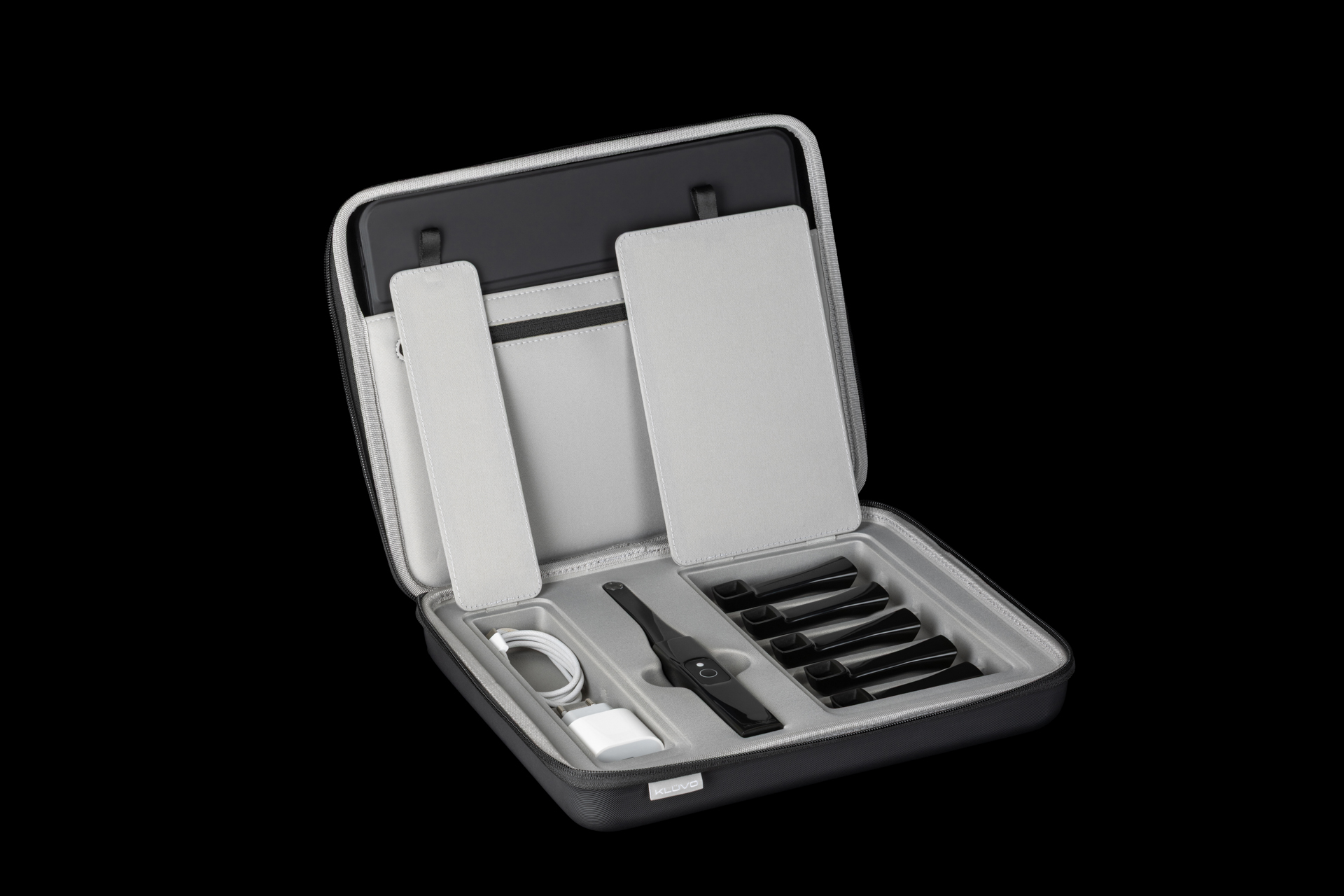
This happens to companies entering a market they did not create. The market already has names for things, and the closest one gets used. The closest name was scanner, and it was the wrong one.
Three things had to change. The category had to be named, because nobody saw it. The specifications had to move from being the argument to being the evidence for it. The website had to be friendly to a dentist while selling an investment.
THE OBJECTION
The founder rejected the word. A camera reads cheap and a scanner reads expensive, and in a dental practice that is not a matter of taste — an intraoral camera is a chairside accessory and an intraoral scanner is capital equipment.
He was right, and he had better grounds for it than most people would have had. The fear was in his brief from the first week: the company had to avoid reading playful “at all cost,” and would rather read a little too boring to begin with. So was the reason. “We had a B2C product before, now we need to fully focus on dental professionals and the branding needs to change.” That earlier product was a camera — a consumer device sold to households, with an app, a cartoon character, and a badge for brushing well. He was not resisting an unfamiliar word. He was resisting one he had already used, for the cheapest thing the company had ever made.
The answer was the other half of the finding. Cheap to a dentist. The next person who would be asked for money was not a dentist, and an investor is not buying the device. He is buying what the company can own — and a company that describes its product in someone else’s category has given that away before the first meeting.
Four months after the brief, the founder was using the category himself, deciding how to propagate it:
“I like dental that you used instead of intra. I will replace my intraoral all across. So we just introduced it — the first 3D dental camera.”
“It’s simple, right? It’s like that’s what we built — 3D camera.”
03Rebuild
THE NAME
The name had two jobs. It had to work for a product that would be its own category to an investor and a scanner to a dentist. And it had to work for the company, which intended to build more than one product.
That ruled out anything descriptive. A name built from a category stops being true when the category changes, and this company already changed once.
Sixty-eight names across three rounds. Klüvo survived all three.
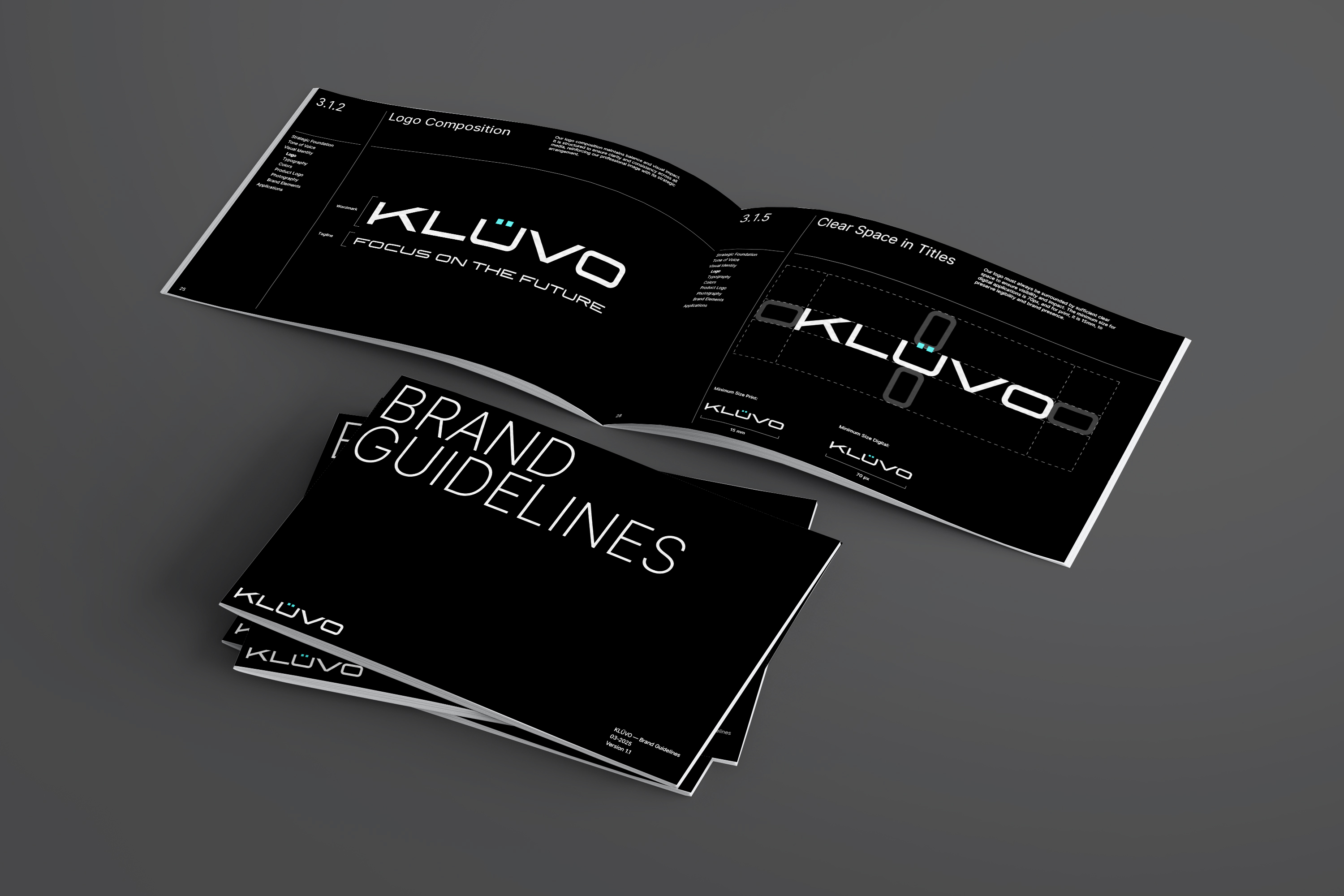
Klüvo is invented and means nothing, which is the argument for it. It belongs to no category, so no category can take it back, and it still fits the company now that the company is building past its first product.
THE SITE
There were no decks, no sales team, no pipeline, and no other material of any kind. One website was the whole of what the market could reach, and it had to hold two readers at once without either interfering with the other.
Those two are compatible. What an investor wants to see is a company a dental professional would take seriously. What he does not want to see is a company that looks like it is raising rather than selling.
By then the founder was making the same split himself: “These are their technology pain points. These are not the dentist pain points — where the technology is weak, because it’s bulky, heavy, only runs on a dedicated gaming laptop.”
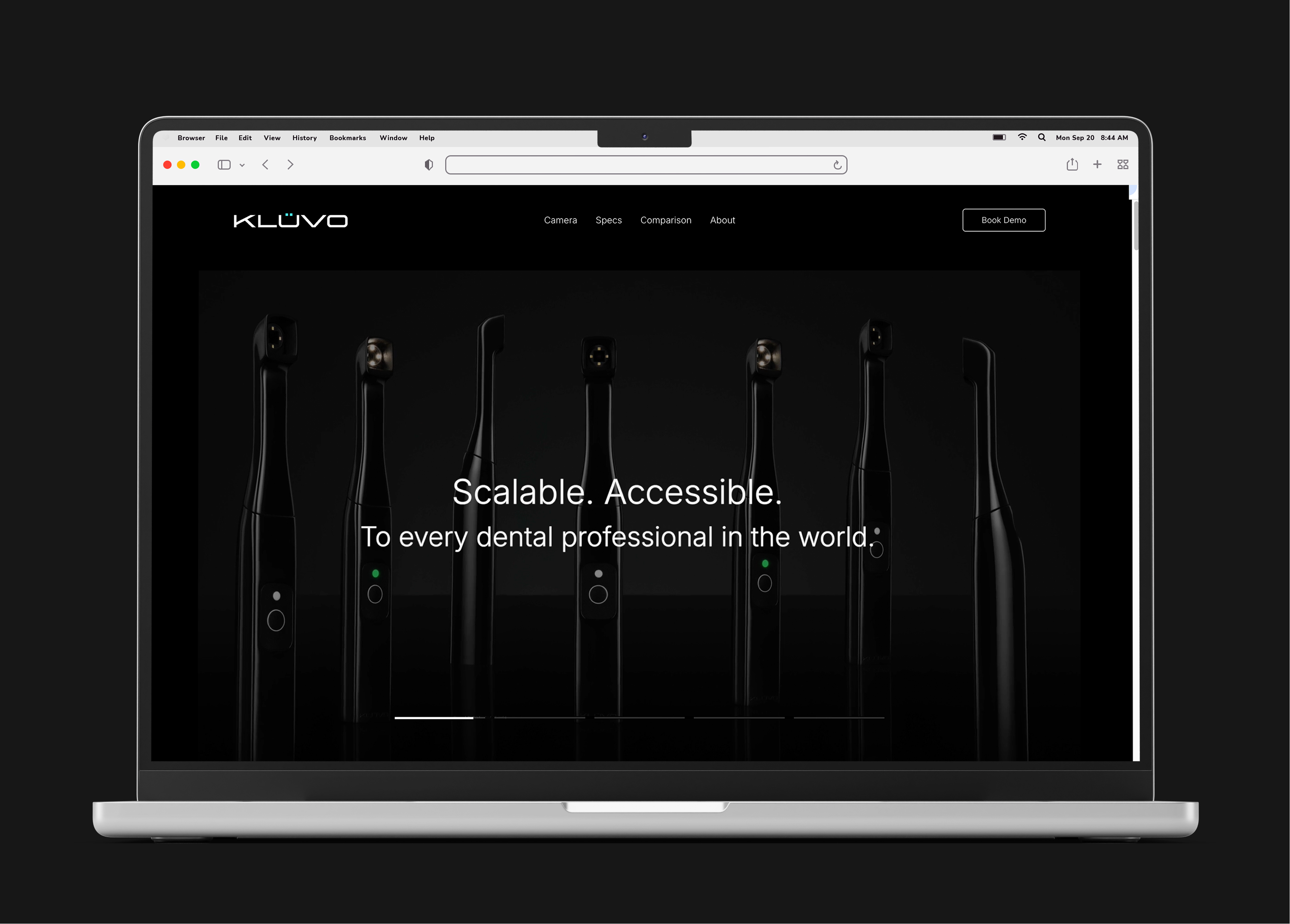
So the site addresses a dental professional and is structured for an investor. The call to action is a demo booking. The argument underneath it is an investment case, in the order an investment case is made.
The homepage opens on the category, before anything about the product. The technology comes second, named as the company’s own. Portability comes third, where it now works as evidence rather than as the claim. Fourth is scaling — the number of practices the device could reach.
A dentist has no use for the fourth. He is buying an instrument, not market share. That slide is on the page for one reader, and everything above it establishes what he is being asked to price.
The comparison table went onto the site with its substance unchanged. Under the old category it was a list of ways the device beat the scanners. Under the new one it is the proof of the claim in the headline above it.
04Sale
The site launched in April 2025. Roughly six months later the company reached its funding goals and moved into industrialization.
The engagement produced a category claim, a name, and a website. It did not by itself produce the round, so all we can establish is the order of events, not causality. In a complex sale no one can isolate a percentage. What can be shown is what changed, when, and what followed.
The evidence of the change is what happened to the account afterward, without us in it.
At launch the company described itself in three sentences:
- Klüvo has globally unique expertise in AI and computer vision applied to dental 3D scanning.
- Leveraging the power of artificial intelligence, we democratize access to digital dentistry.
- We are backed by industry leaders to drive innovation and excellence.
A year later the same page says:
- Klüvo has globally unique expertise in AI and computer vision applied to dental 3D scanning.
- Klüvo is an independent, VC-backed deep-tech company with full ownership of its proprietary technology and an expanding patent portfolio — extending beyond the first 3D dental camera.
The shift is from a broad technology claim and a general mission statement to independence, VC backing, full ownership, and expansion.
The last description is the one that could not have been written under the old account. A better scanner has a roadmap of specifications and nothing beyond. A new category has a floor to build on and no cap, which is what the company is building.